If you've ever felt confused by the term AI agent, you're not alone.
Most explanations focus on the technology:
"Agents use reasoning.""Agents use tools.""Agents can plan."
All of that is true. None of it tells a business leader when the difference actually matters.
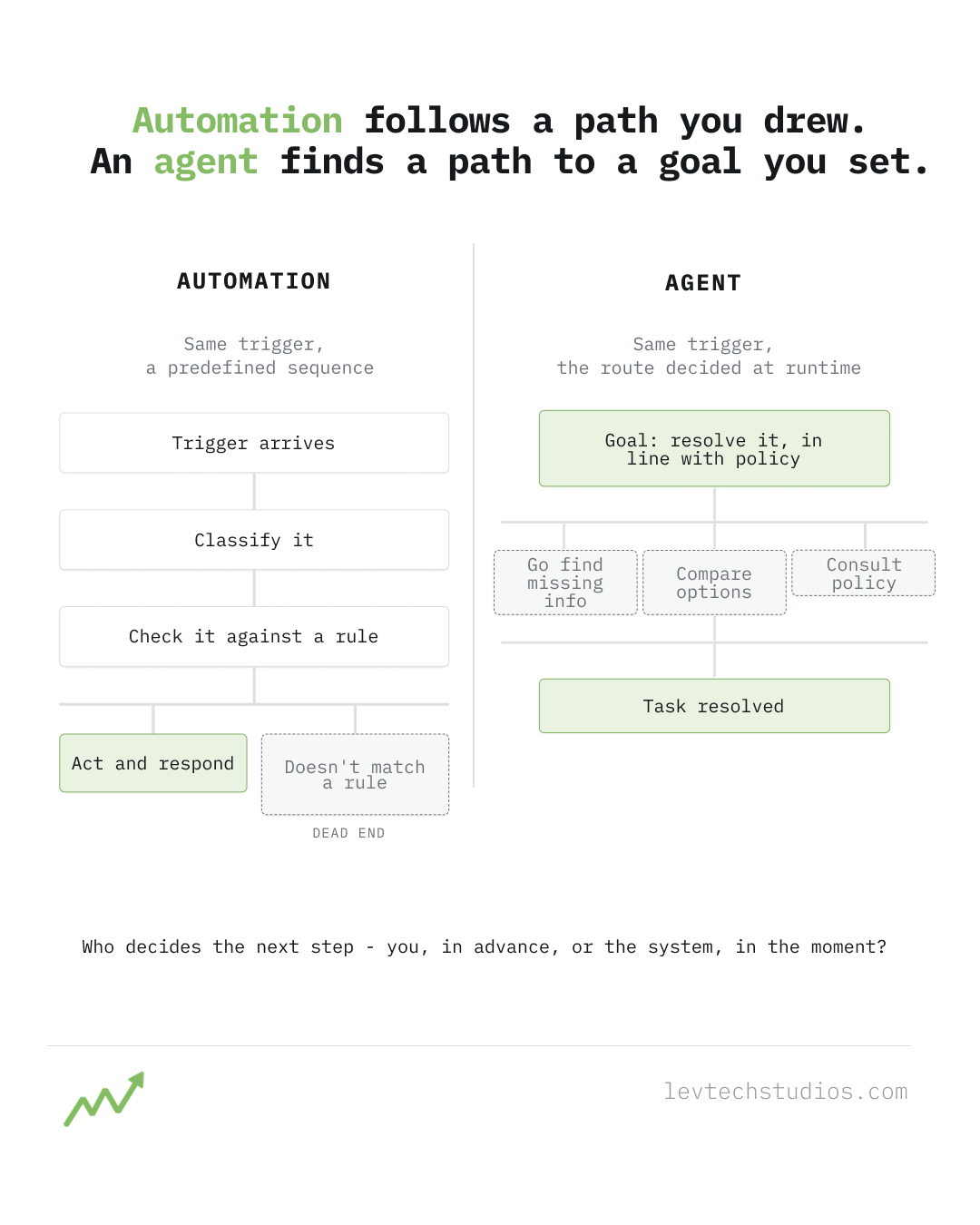
The clearest way to explain it turns out to be simple: show the same trigger handled twice, once by automation, once by an agent.
On the happy path, the two look almost identical. The difference only shows up when reality goes off-script.
Imagine something happens that needs a response. Call it a trigger. It could be an email, a form submission, a support ticket, a sensor reading. What it is doesn't matter. What matters is what happens next.
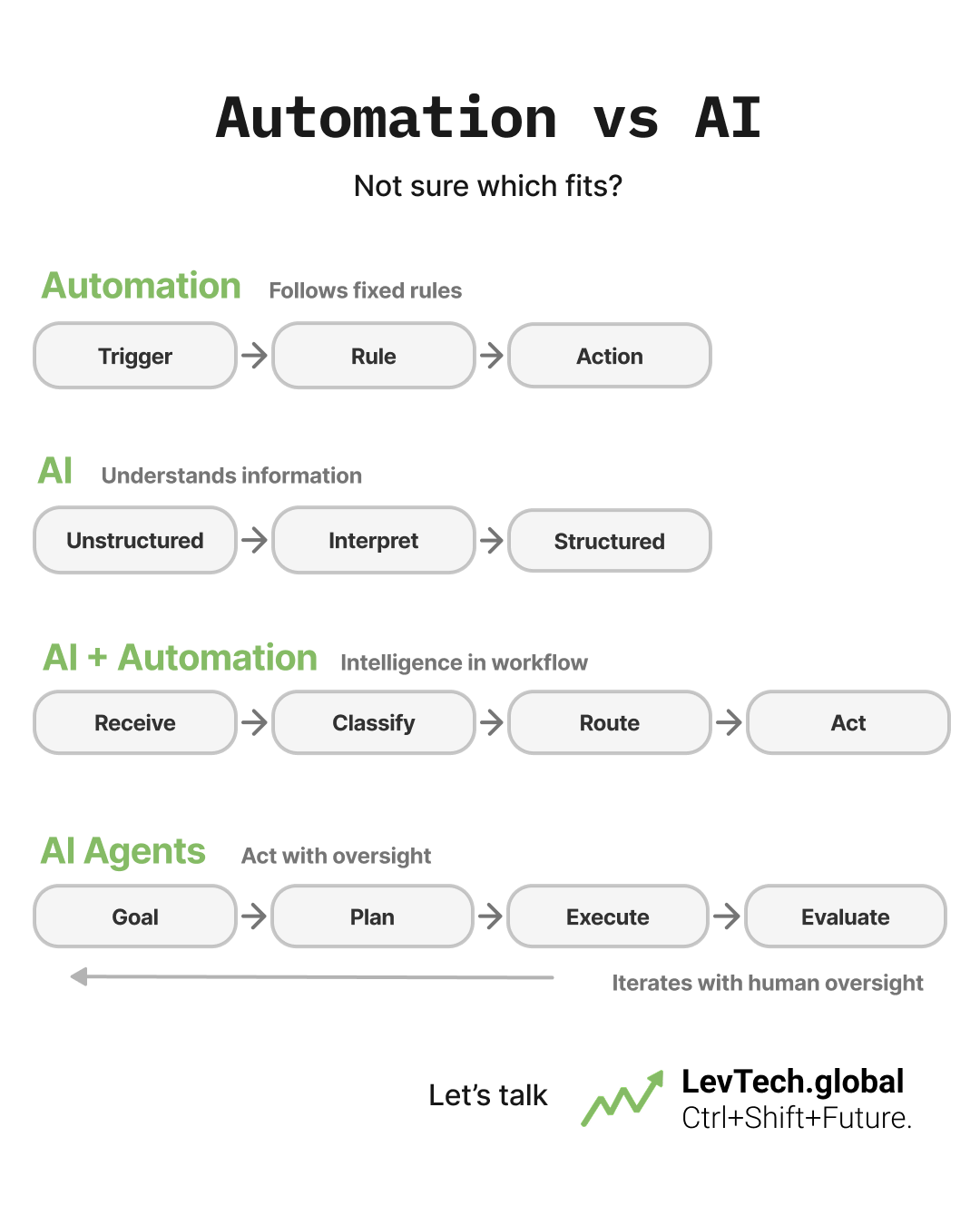
This is a workflow with AI embedded inside it. The steps are fixed in advance:
It's fast. It's inexpensive. It's predictable. For the overwhelming majority of routine cases, it's exactly what you want.
But then something the workflow wasn't built for happens. A piece of information is missing. The trigger doesn't quite match any of the rules. The automation has nowhere to go, so it dead-ends and hands the case to a person.
Now give the system a goal instead of a script:
Goal: resolve this in line with policy.
Instead of following a predetermined sequence, the agent decides what to do next, in real time. It might:
Nobody wrote that exact sequence in advance. The agent worked it out while solving the problem.
If you only remember one sentence, make it this one:
Automation follows a path you drew. An agent finds a path to a goal you set.
Or, in business terms: automation breaks when reality doesn't match the flowchart. An agent exists for the situations where you can't draw the flowchart in the first place.
The common question is, does it use an LLM?
That's the wrong question. Almost everything will, soon enough. The question that actually tells you what you're looking at is: who decided the next step?
If a human designed the sequence in advance, it's automation, no matter how much AI sits inside each step. If the system decides the sequence while it's solving the problem, it's an agent.
Not the model. Not the vocabulary. The decision-making.
People tend to talk about agents as the next evolution of automation, a newer, smarter version of the same thing.
They're not. They're different tools for different jobs.
If a process is repetitive, predictable, high-volume, and governed by clear rules, automation is almost always the better choice. It's cheaper, faster, easier to audit, and it behaves the same way every time.
Agents come with real trade-offs. They cost more to run. They take longer. They may take a different, but equally valid, route to the same result each time. That flexibility is exactly what makes them useful, and exactly why they shouldn't be used everywhere.
Choose automation when:
Choose an agent when:
The future isn't agents replacing automation. It's knowing where each one belongs.
Use automation when you can define the process. Use an agent when you can only define the outcome.
That's the distinction that actually matters.
Not sure which one your business actually needs?
That's usually the right question to start with. LevTech Studios helps businesses figure out where automation solves the problem cleanly — and where an agent is the only thing that will work.
Talk to us at levtechstudios.com/contact